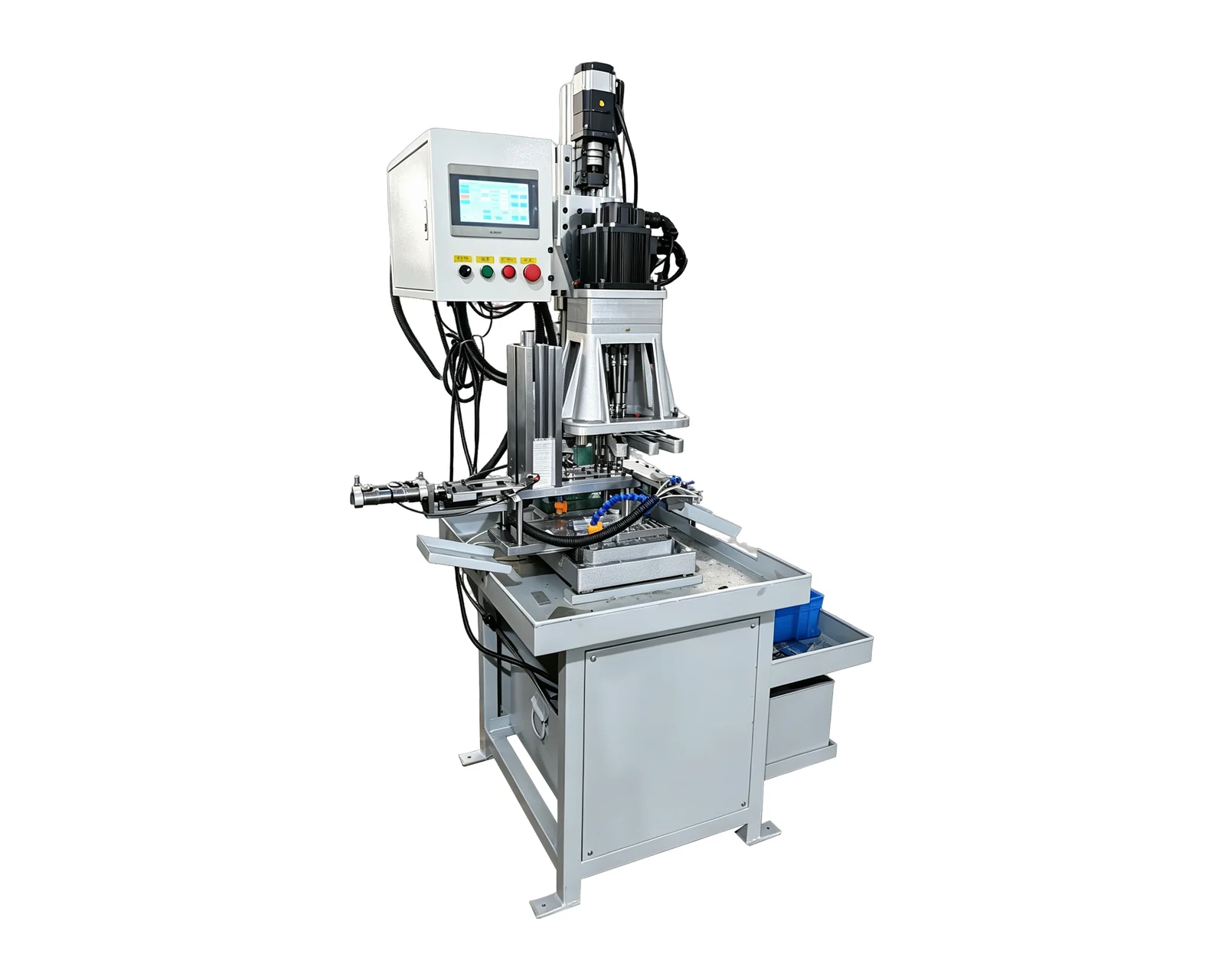
Explore equipment for your inquiry
Dual-Servo Multi-Spindle Drilling & Tapping Machine →Review the published specifications and configuration options against your part drawing before requesting a quote.
Start with the work an operator actually performs
Measure hands-on work for representative production, not just spindle-running time. List loading, unloading, checking, replenishing, clearing routine interruptions and changing the setup. Distinguish operator work from machine elapsed time. Two activities that overlap in the cycle do not necessarily create two separate labor savings; use a timeline to identify what the person can actually leave and do elsewhere.
Then ask the production manager how released time will be used. Eliminating demonstrable overtime is different from making an existing operator available for another task during an unchanged paid shift. Both can be useful, but the second does not immediately reduce payroll. If the plan depends on tending another machine, validate walking, attention, interference and permitted operating arrangements rather than dividing total cycle time by operator touch time.
Worked example: calculate net released hours
The following numbers are hypothetical and do not represent BINSING performance. Assume 60,000 accepted parts per year. The current route requires 45 seconds of operator work per accepted part, or 60,000 × 45 ÷ 3,600 = 750 hours annually. The proposed route requires 18 seconds per accepted part, or 300 hours annually, plus 90 additional annual hours for replenishment, changeovers and routine support not included in that 18-second measure.
Net released time = 750 − 300 − 90 = 360 hours per year. The gross difference of 450 hours would overstate the benefit because it ignores the additional tasks. Before using these inputs, define what each observation includes and check representative batches. Retain the 90-hour allowance as a visible item so it can be replaced with trial evidence. Inspection tasks already included in per-part time must not be counted again in the allowance.
Convert only the supported portion into avoided spending
Assume an avoidable paid cost of USD 24 per hour and an initial investment of USD 24,000. Also assume USD 1,200 per year of additional nonlabor operating expense, with no other savings in this illustration. The hourly value must describe spending that actually changes, rather than an accounting rate containing costs that remain fixed. Let f be the fraction of the 360 hours that removes paid spending.
Annual net cash benefit = 360 × f × 24 − 1,200. Simple payback = 24,000 divided by that annual benefit, provided the benefit is positive and stable. The U.S. SBA's break-even guidance emphasizes separating fixed and variable costs; here that distinction helps identify which labor-related costs actually change. The time model and conversion examples are original illustrations, not values supplied by that source.
Record capacity benefits without duplicating the hours
If the operator remains on the same paid shift and uses released time to perform needed work elsewhere, show that as redeployed capacity. It may avoid future hiring or support additional saleable output, but those outcomes need a separate demand and staffing explanation. Do not count the same hour as both removed payroll and productive work by an employee who is still being paid for it.
This simple payback excludes financing, tax, discounting, residual value and output-related benefits. It assumes the target volume remains achievable and the annual task allowance remains representative. For a purchasing review, place the observation sheet, staffing explanation and operating-cost assumptions beside the machine quote. Ask a supplier to demonstrate a complete work sequence, including activities outside the automatic cycle, before treating the estimate as validated.