
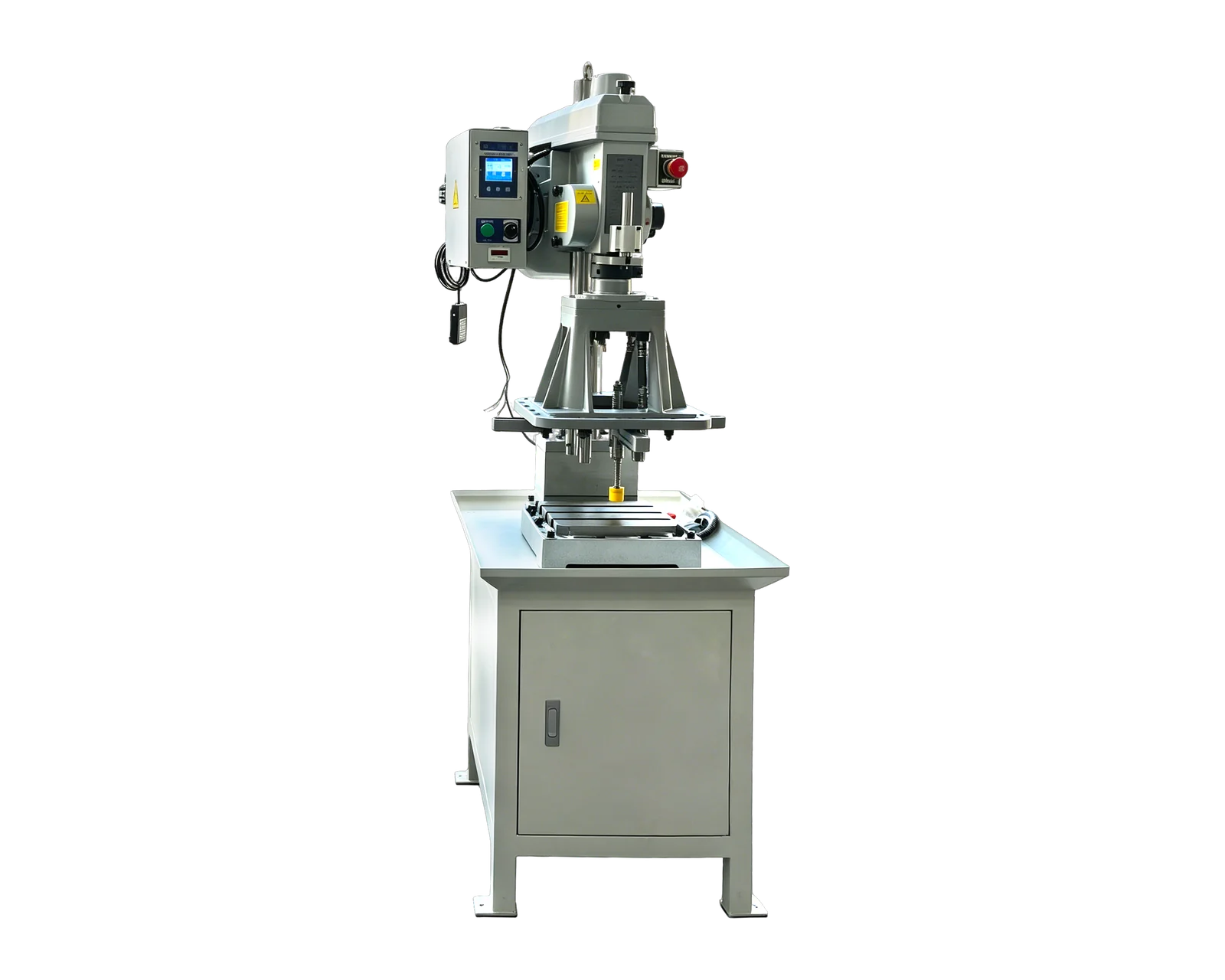
Explore equipment for your inquiry
4508 Gear-Driven Automatic Tapping Machine →Review the published specifications and configuration options against your part drawing before requesting a quote.
Define one complete observation unit
The existing consumables-record guide explains what to record. This article turns those records into an original calculation. Define the part revision, material state, incoming hole condition, tool identity and inspection boundary before comparing results. Record all processed parts and accepted parts in the same observation window. A tool replaced after a short trial has not necessarily reached its usable production life.
For a multi-spindle machine, identify whether the record concerns one tool position or a complete set. If only one position is replaced, charging a whole set would overstate consumption. If each part needs several threads, a life measured in holes cannot be used directly as a life measured in parts. The simple example below assumes one tool makes one thread in each processed part.
Use a formula with an explicit reject-cost boundary
Let P be the price of one consumed tool, R its incremental replacement-event cost, N the parts processed during its life and q the accepted fraction. Accepted output is N × q. Let S be the assigned cost per rejected part, excluding the tool and replacement amounts already counted. Modeled cost per good part is [P + R + N × (1 − q) × S] ÷ (N × q). This is a selected cost subtotal, not the full manufacturing cost.
Replacement cost R might include a specifically paid external service or other incremental expense. Do not insert ordinary salaried labor as a cash outflow merely because replacement takes time. Record stopped minutes separately. Reject cost S must follow one consistent boundary, such as purchased blank cost with no recovery; if the business uses a different basis, label it and avoid counting the same loss elsewhere.
Compare two hypothetical tools on the same basis
Assume no recovery value, S = 2 currency units per rejected part and an independently defined replacement-event cost R = 8. Tool A costs 40, processes 1,000 parts and yields 980 accepted parts. Its subtotal is (40 + 8 + 20 × 2) ÷ 980 = 0.0898 currency units per good part. These are invented inputs, not tool-life claims or recommended process settings.
Tool B costs 60, processes 1,800 parts and yields 1,764 accepted parts at the same 98% acceptance. Its subtotal is (60 + 8 + 36 × 2) ÷ 1,764 = 0.0794. Although B has a higher purchase price, it has a lower subtotal in this model. The example assumes comparable conditions and does not establish that tool choice caused the observed reject rate. Verify that relationship before making a tooling recommendation.
Keep replacement time and quality evidence beside the subtotal
Suppose an illustrative replacement stops the station for eight minutes. At 1,000 processed parts per tool that is 0.008 stopped minutes per processed part; at 1,800 it is approximately 0.00444. This time allocation can support capacity planning. It is not an additional monetary charge unless a clearly defined cost changes, and it should not duplicate the event expense already included in R.
Do not extend tool use merely to improve the arithmetic. The replacement criterion should follow the approved process and acceptance requirements. Retain the reason for each replacement and feature-level inspection evidence. An apparent life increase that shifts defects into downstream assembly is not an improvement within a consistent accepted-part boundary. A short comparison also may not capture occasional breakage or variation between material lots.
Request comparable evidence instead of a universal tooling cost
Provide current tool references, observed replacement quantities and accepted-output records with the drawing. Ask how the proposed equipment supports the actual tooling arrangement and what remains to be established through trial. BINSING's tapping platform provides a starting point for this discussion; a catalog image does not establish life, tooling compatibility or a guaranteed cost.
If records are incomplete, present a range of plausible inputs and identify which trial observations would narrow it. Keep purchase inventory, consumed tools and reusable stock separate. Update the model when actual observations become available, preserving the original assumptions so the buyer can see why the conclusion changed. This is more useful than comparing tool prices alone.
