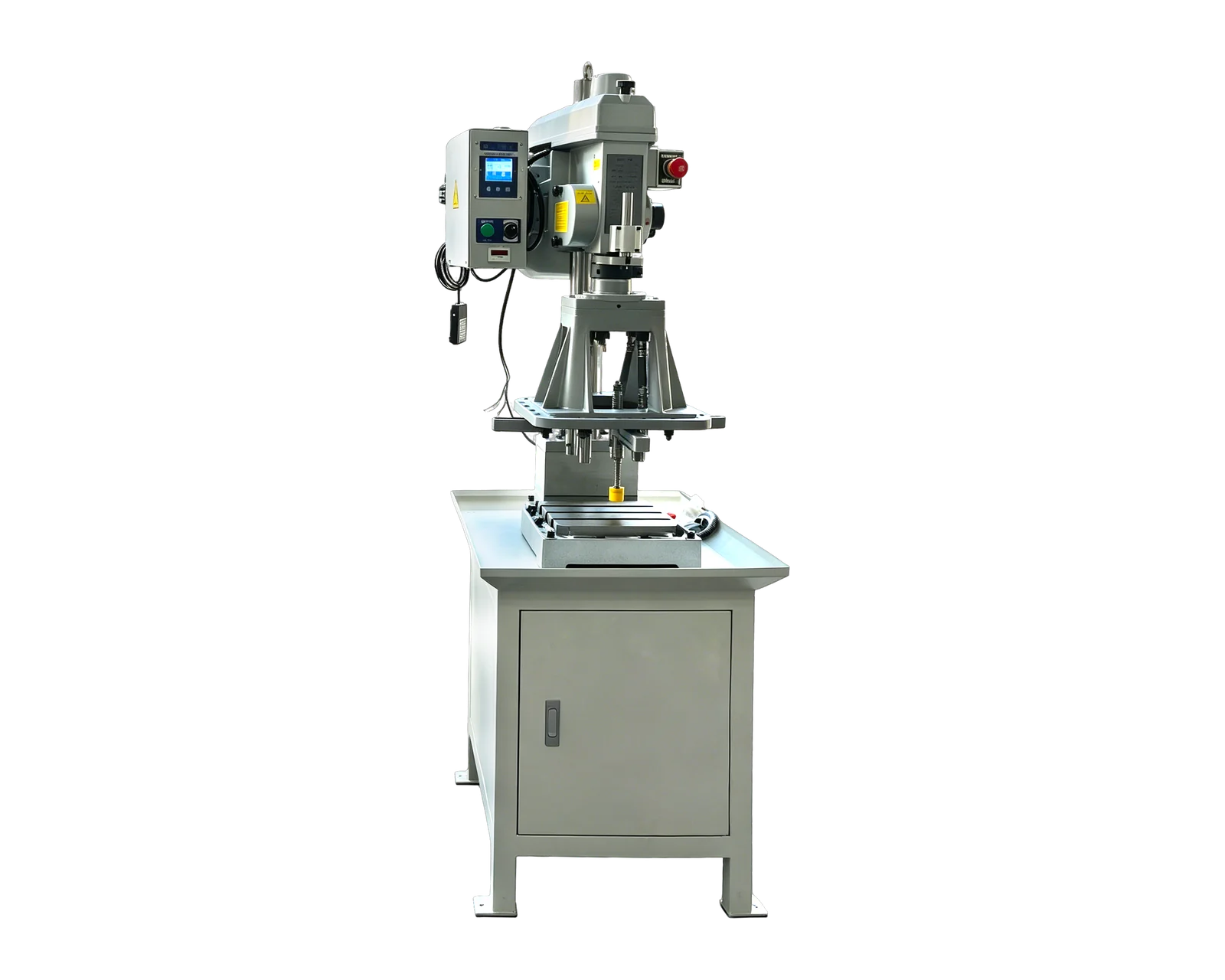
Explore equipment for your inquiry
Dual-Servo Multi-Spindle Drilling & Tapping Machine →Review the published specifications and configuration options against your part drawing before requesting a quote.
Separate the cycle name from the holder name
Rigid tapping describes a machine-cycle concept; it does not mean that every suitable holder has zero axial movement. EMUGE explains that its Softsynchro holders use small push-and-pull compensation to address differences between synchronous spindle motion and the threading tool. The control still establishes the intended motion. The holder's role is local to the tool connection.
OSG likewise presents SynchroMaster for machining centres with synchronous spindles and identifies a micro compensator for reducing axial forces. These are examples of a functional category, not a specification for BINSING equipment. A quotation should identify the offered holder and the cycle it is intended to accompany instead of relying on the word servo or synchro alone.
Compare functions instead of ranking holder labels
The original matrix below is a reading aid for supplier documents. It separates motion along the tool axis from motion across it. Actual travel, load limits, setup and permitted cycles come from the named holder's documentation; categories alone cannot approve a combination.
Specify the direction before asking for more float
Bilz lists rigid, tension/compression, radial-float and combined versions separately in its quick-change range. This is a useful reminder that quick change describes handling, while compensation describes a different function. Ask whether a proposal intends axial movement, radial movement or both, and obtain the specific assembly reference that provides it.
Suppose a hypothetical buyer describes an old holder simply as floating and wants to reuse it. That description leaves two different questions unresolved: how it moves along the tool axis and whether it permits lateral movement. Photograph the identification and obtain its function drawing. Do not treat visible movement during an informal check as a calibrated operating range or approval for the new machine.
More movement is not automatically a better match
Sandvik Coromant's tapping session describes how an unsuitable floating arrangement can permit a spiral-flute tap to pull ahead of the intended feed. The same discussion explains why holder selection belongs with synchronization. The narrow conclusion is that extra freedom can change the process; it is not a universal improvement or a substitute for a correctly matched cycle.
For an original illustration, imagine two proposed holders whose datasheets state different axial functions. The cheaper unit is not necessarily unsuitable, and the unit with greater movement is not necessarily safer for the thread. Ask each supplier to connect the function to the same machine cycle and selected tool. A comparison based only on compensation travel leaves the essential compatibility question unanswered.
Keep alignment, prepared-hole condition and tool selection as independent review items. If the part or spindle alignment is wrong, naming an axial compensator does not explain how that error will be addressed. State the suspected mismatch precisely, then ask for the relevant evidence rather than requesting a holder that promises to solve all tapping faults.
Check the complete assembly after the function is chosen
OSG's SynchroMaster page distinguishes its collet and coolant arrangements and notes a model exception to its square-hole feature. This illustrates why the full product reference matters: a family name does not describe every detail of every size. Obtain the actual holder, collet and tap references together, with their permitted mounting and coolant arrangements.
Create one assembly entry per proposed combination, showing the machine-side interface, tool shank, assembled length and the manufacturer's relevant restrictions. Include any adapter rather than treating it as an invisible connection. If the quote offers several options, compare them at the same complete-assembly boundary so a missing component is not mistaken for a lower-cost equivalent.
For multiple tapping positions, identify which assembly serves each position. Do not assume that the holder approved at one spindle is interchangeable everywhere simply because the threads share a nominal size. Ask the layout reviewer to resolve the installed envelope and access for the actual combination.
Request a documented match, then verify the affected result
The useful deliverable is a short compatibility statement linking the machine cycle, holder function and tool assembly. It should state the chosen components, any required setup and the result to be checked when that arrangement is tried. If a holder changes after the trial, identify which conclusions need review instead of silently carrying approval across.
Send BINSING the existing cycle description, holder identification and tap reference with the part requirement. If those documents are unavailable, make the missing information explicit. The resulting review can determine what must be confirmed for the offered platform; this article does not certify a holder brand, an unsupported interface or a guaranteed tool-life improvement.