
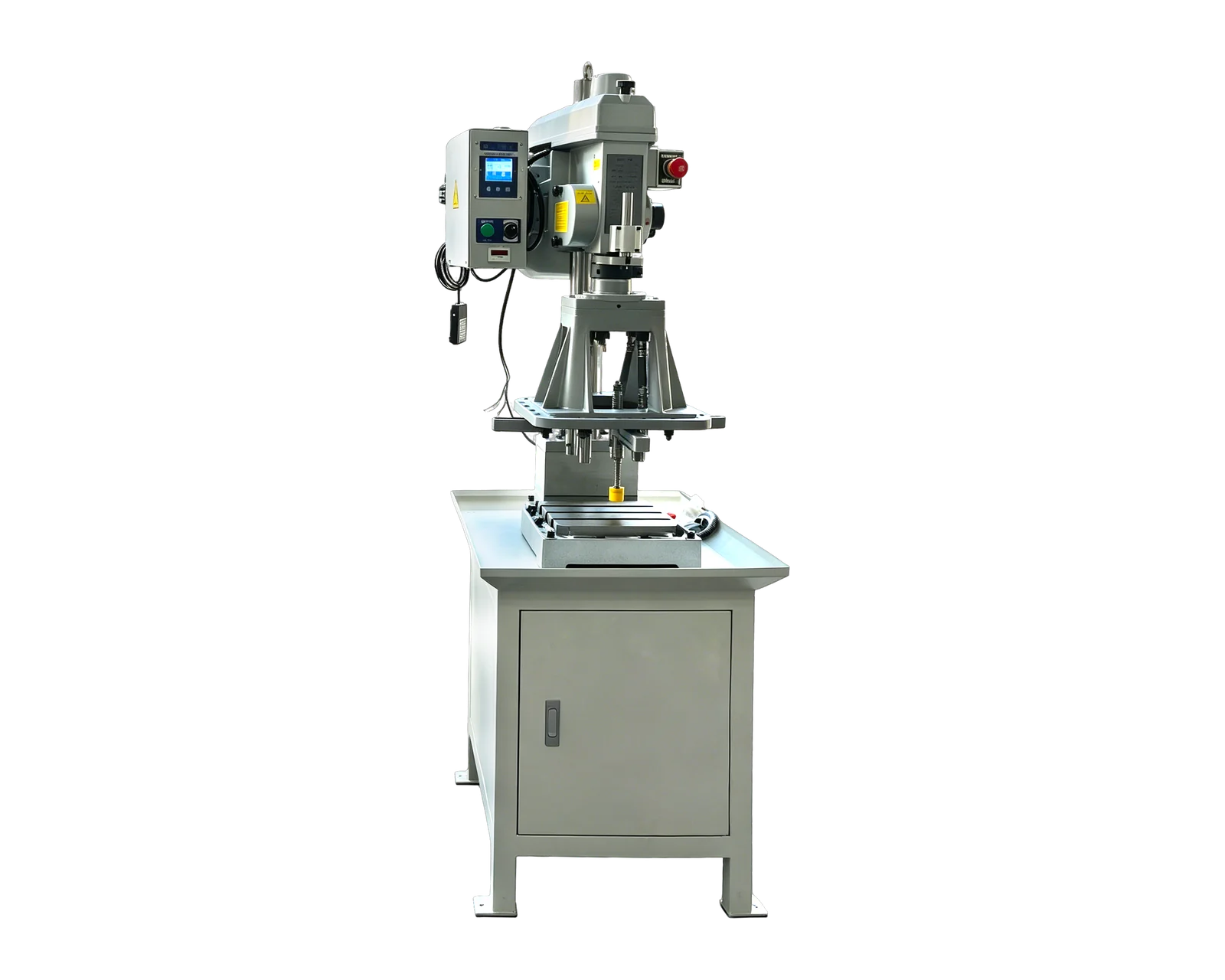
Explore equipment for your inquiry
Automatic Tapping Machines →Compare tapping platforms and feeding options before defining your thread-machining inquiry.
First establish what arrives at the tapping station
Does the workpiece arrive with prepared holes, or must the proposed equipment drill and then tap? List any chamfering, cleaning, inspection or handling required around those operations. A quotation for a tapping platform and a quotation for an integrated drill-and-tap process may have different boundaries.
For every thread, provide its size, pitch, required depth and through-hole or blind-hole condition. Specify the material and show the prepared-hole dimensions when available. If two suppliers are assessing different incoming conditions, their machine recommendations and prices will not be directly comparable.
Compare these two platforms by confirmed features
The catalog describes BX-4508V as a gear-driven tapping platform with pitch gearing and single or multi-spindle tooling options. BX-20015 provides servo spindle rotation and servo feed with a multi-spindle arrangement selected for the application. Use those descriptions to ask focused questions, rather than assuming an automatic quality or output advantage.
Ask for a changeover walkthrough
Provide the intended part family and identify what changes: thread pitch, hole spacing, depth, workpiece length or material. Ask the supplier to describe the required changeover from one named part to another. A useful answer identifies replacement components, adjustments and checks before production resumes.
Avoid treating servo control as a promise that every change is software-only. The head, tool spacing and fixture may still be specific to a part. Likewise, a stable repeated job may deserve a gear-platform assessment without assuming that a simpler control description makes it unsuitable. The actual work determines the comparison.
For a purchasing comparison, ask each proposal to list one initial production setup and one named changeover. Keep the machine base, pitch or control setup, multi-spindle head, holders, fixtures and loading equipment visible as separate inclusions or exclusions. No universal price ranking follows from gear-driven versus servo alone.
Use the same part and acceptance criteria
To compare proposals fairly, use the same drawing revision, incoming material and prepared-hole condition. Agree how thread acceptance will be checked, which characteristics matter and what samples are required. Ask each supplier to identify the offered tooling and the scope of any application trial.
Separate cutting time from a complete production cycle. If one demonstration uses hand-loaded parts while another includes a feeding arrangement, describe that difference in the comparison. Quoted output should state its conditions; a brief demonstration video does not establish sustained output on your component.
Choose against the purchasing requirement
The BX-4508V is a candidate for repeated tapping when pitch, tooling and workholding can be defined. The BX-20015 is a candidate when the task calls for the cataloged dual-servo multi-spindle platform. These are starting points for assessment, not a substitute for confirming the complete application.
If the requirement includes automatic part orientation, several machining faces or a linked multi-stage sequence, expand the comparison to a custom cell. Ask for a written scope that distinguishes included equipment, application-dependent options and items supplied by your factory. This often resolves more purchasing uncertainty than the drive label alone.
Keep machine drive, tap process and holder function as separate decisions. Cutting versus forming taps needs its own material and pilot-hole review; synchronized feed and holder compensation need a documented interface match. Use the related technical guides for those decisions, then bring their confirmed requirements back into the same equipment quotation.
