Explore equipment for your inquiry
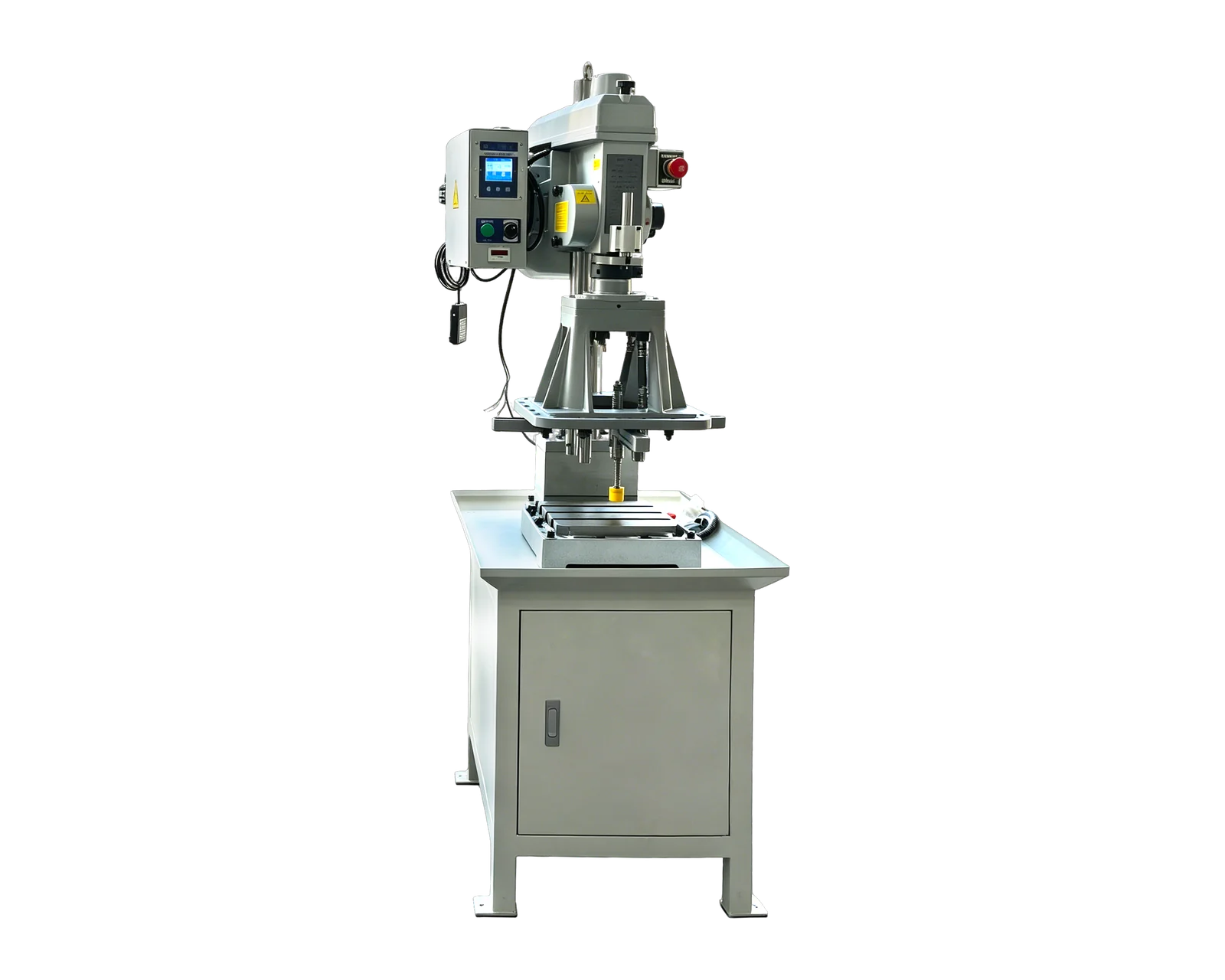
Dual-Servo Multi-Spindle Drilling & Tapping Machine →Review the published specifications and configuration options against your part drawing before requesting a quote.
Distinguish spindle rotation from travel around the hole
For a conventional single-start tapped thread, axial advance per tool revolution follows the thread pitch. OSG's technical discussion contrasts this pitch-linked motion with thread milling, where cutting speed and feed can be selected separately. In ordinary tapping the tool enters and reverses out along the feature; a programmable feed alone does not turn that operation into milling.
Sandvik Coromant describes thread milling as circular ramping with a rotating tool. On a typical machining centre, X and Y create the circular path while Z supplies the axial movement. The cutter rotates about its own axis while its centre travels around the hole axis. These are distinct motions: a revolution of the cutter is not a revolution around the hole.
Compare the movement the supplier must demonstrate
Use this original matrix to separate positioning functions from machining functions. The machine may have a moving table, several spindles or a servo-controlled feed, but those labels do not establish simultaneous contouring. Ask for a description tied to the actual thread feature and offered control configuration.
Confirm the control function, not just the number of axes
OSG specifies simultaneous three-axis control and helical interpolation for its machining-centre thread-milling tools. Its range also includes program-generation and diameter-correction support. For purchasing, request the exact control function and supported program workflow. A list of independent axis travels does not show whether they can execute the required path together under cutting load.
Machine architectures differ. CMZ describes a lathe implementation using live tooling; in its stated spindle-centred case, a special program combines Z and C movement, while other cases require Y capability. That example is a reason to obtain a machine-specific motion explanation, not to assume every lathe or tapping platform can use the same arrangement.
Evaluate flexibility against actual thread features
OSG notes that suitable thread mills can cover different thread diameters sharing a pitch and can adjust thread dimensions through the process. Treat that as a reason to investigate tooling coverage, not a promise that one cutter handles every thread. Ask the tool supplier to confirm profile, pitch, minimum accessible diameter, reach and required length for each proposed feature.
In a hypothetical part family with three internal thread sizes, purchasing might expect one milling tool to replace three taps. Build a row for each drawing feature and record the approved tool and program reference. If one feature needs a different pitch, reach or geometry, retain that difference in the cost comparison. Count the tools actually confirmed for the family rather than a theoretical minimum.
Compare routes after the motion requirement is satisfied
A useful first comparison is between an available tapping route and an available machining-centre route. If the part already visits the machining centre for other features, include the additional threading operation within that existing route. If milling introduces another transfer, include loading, locating, programming and inspection at that additional step. The same tool operation can have very different production implications in those two situations.
Do not rank the routes solely by spindle speed or a demonstration clip. Request a timing breakdown for preparation, tool approach, machining, exit, changes and handling. Keep accepted parts as the output basis and list which assumptions remain estimates. A dedicated tapping arrangement deserves a part-specific review for repeated work, while thread milling deserves review when its motion and tooling flexibility answer a defined requirement.
For a high-value hypothetical component, a buyer might place extra weight on the plan for tool damage and recovery. Ask each process supplier to explain the actual contingency and what happens to the workpiece. Do not turn a general advantage attributed to one tool type into a guarantee that no part can be scrapped. Compare the offered process and evidence, including its limitations.
Request the drilling and tapping scope explicitly
For a BINSING inquiry, submit the drawing and identify which operations you want evaluated for dedicated drilling or tapping equipment. If thread milling is a candidate on an existing machining centre or another supplier's equipment, show it as a separate route for comparison. The BINSING platform pictured here does not establish thread-milling capability.
Ask for a response that marks the included features and any operations left elsewhere. Bring the same required finished thread, part condition and acceptance basis to both discussions. The result should be a process decision with known machine requirements, rather than an attempt to make an unsupported operation fit a preferred machine name.