
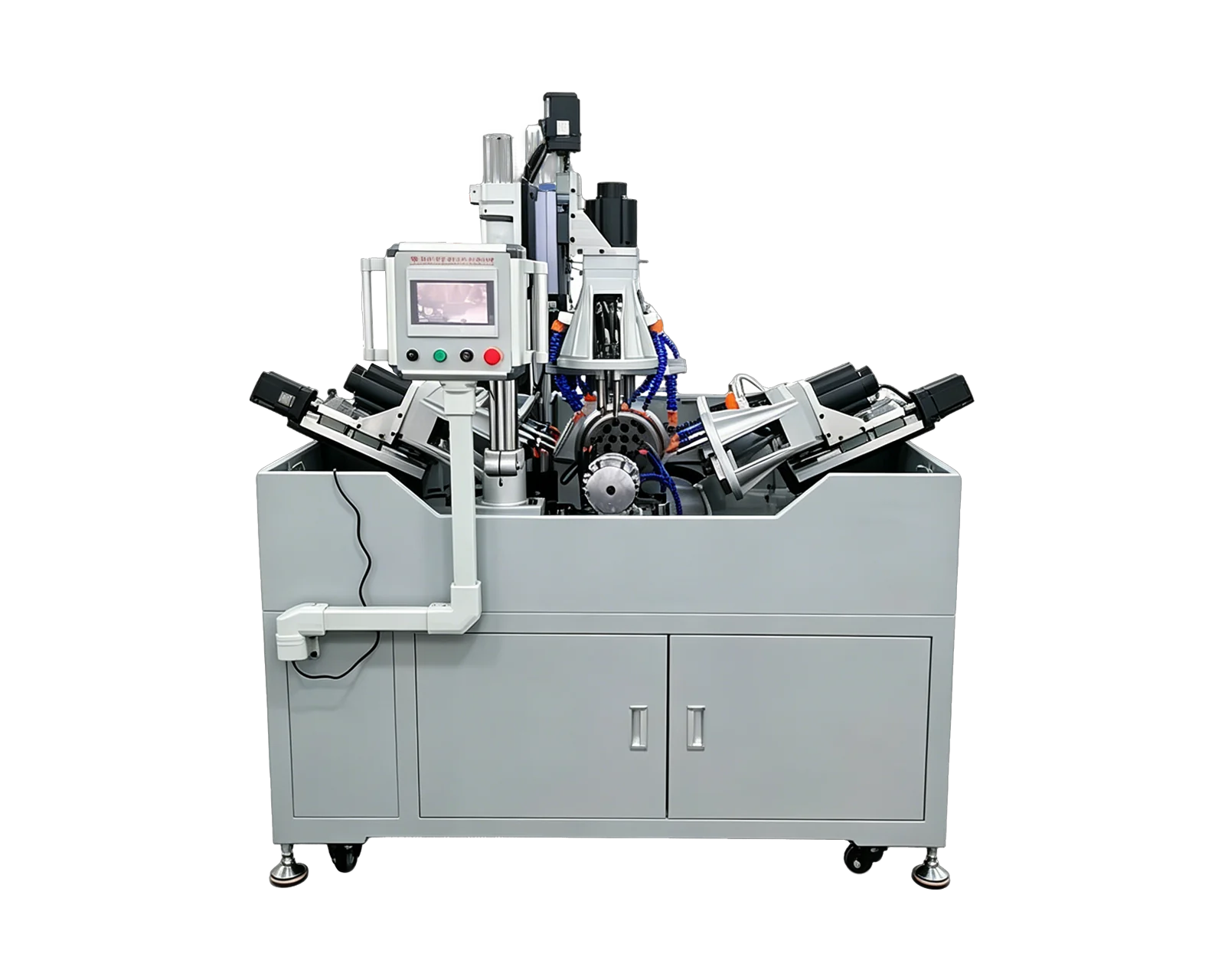
Explore equipment for your inquiry
Multi-Side Drilling & Tapping →Review the layout options and required part information to define the scope of a custom equipment inquiry.
1. Identify the housing stage being quoted
A finished pump housing drawing can show surfaces that do not yet exist when the part reaches drilling and tapping. Send a separate incoming-stage drawing or a clearly marked operation drawing. Identify completed faces, unfinished allowances and operations planned after this station. Include the material designation and actual supplied condition so the equipment review begins with the workpiece that will be loaded.
Give the stage a route reference, not just a description such as partly machined. If several upstream routes are approved, record the differences that affect location or access. A proposal based on a finished mounting face cannot automatically cover a route where that face is produced later. Ask suppliers to state the incoming stage used in their assumptions and flag any preparation they expect another operation to provide.
2. Organize the inquiry around assembly interfaces
List the requested features by the interface they serve: for example, a specified cover pattern, mounting arrangement or attachment feature. Preserve the approved drawing definitions rather than deriving dimensions from mating components. This makes the inquiry about the relationship between machining and assembly references, rather than a generic list of housing openings. Use the following fields to compare responses feature by feature.
3. Show protected regions alongside usable references
Mark the regions whose supplied condition must be preserved, including any surfaces designated by the component owner as finished assembly or sealing areas. Also identify permitted contact regions. Ask for the proposed location to be explained against the complete housing envelope. Providing only the face containing the requested holes leaves surrounding projections, openings and contact restrictions outside the review.
If more than one setup is proposed, ask which interface features belong to each setup and how their specified relationships will be checked. Do not assume that locating on a convenient exterior surface follows the drawing reference system. Any proposed departure needs technical review by the drawing authority. Keep protection, cleaning and removal of temporary covers as named responsibilities rather than silently assigning them to the machine operator.
4. Compare two routes without treating them as equivalent
Hypothetical purchasing example: the same housing part number is available from two upstream routes. One route delivers the mounting face finished; the other leaves it for a later operation. The buyer requests the same cover threads from both routes. A quote based on the first route does not establish coverage of the second, even though both inquiries attach the same final drawing.
The useful next step is to identify the approved incoming reference features for each route and ask whether the proposal covers one or both conditions. If extra preparation is needed, assign its cost and owner. Record which route supplied any trial samples. This is an inquiry-planning example, not a BINSING installation claim or evidence that a particular machine arrangement suits every pump housing.
5. Request an application response with a defined endpoint
Specify the condition in which the housing must leave this station and the evidence required for the requested holes and threads. Identify who measures each controlled relationship and who provides the inspection resources. Any later assembly, sealing or product-performance assessment belongs to a separately defined scope; a satisfactory drilled sample alone does not establish the performance of a completed pump.
Email BINSING the stage drawings, interface register, protected-region map and expected version mix. Ask the response to identify reviewed revisions, included operations, proposed arrangement and open decisions. Where the quote includes cleaning or part transfer, request their boundaries explicitly. A clear endpoint makes it possible to compare equipment proposals without confusing a drilling and tapping station with a complete housing production route.