
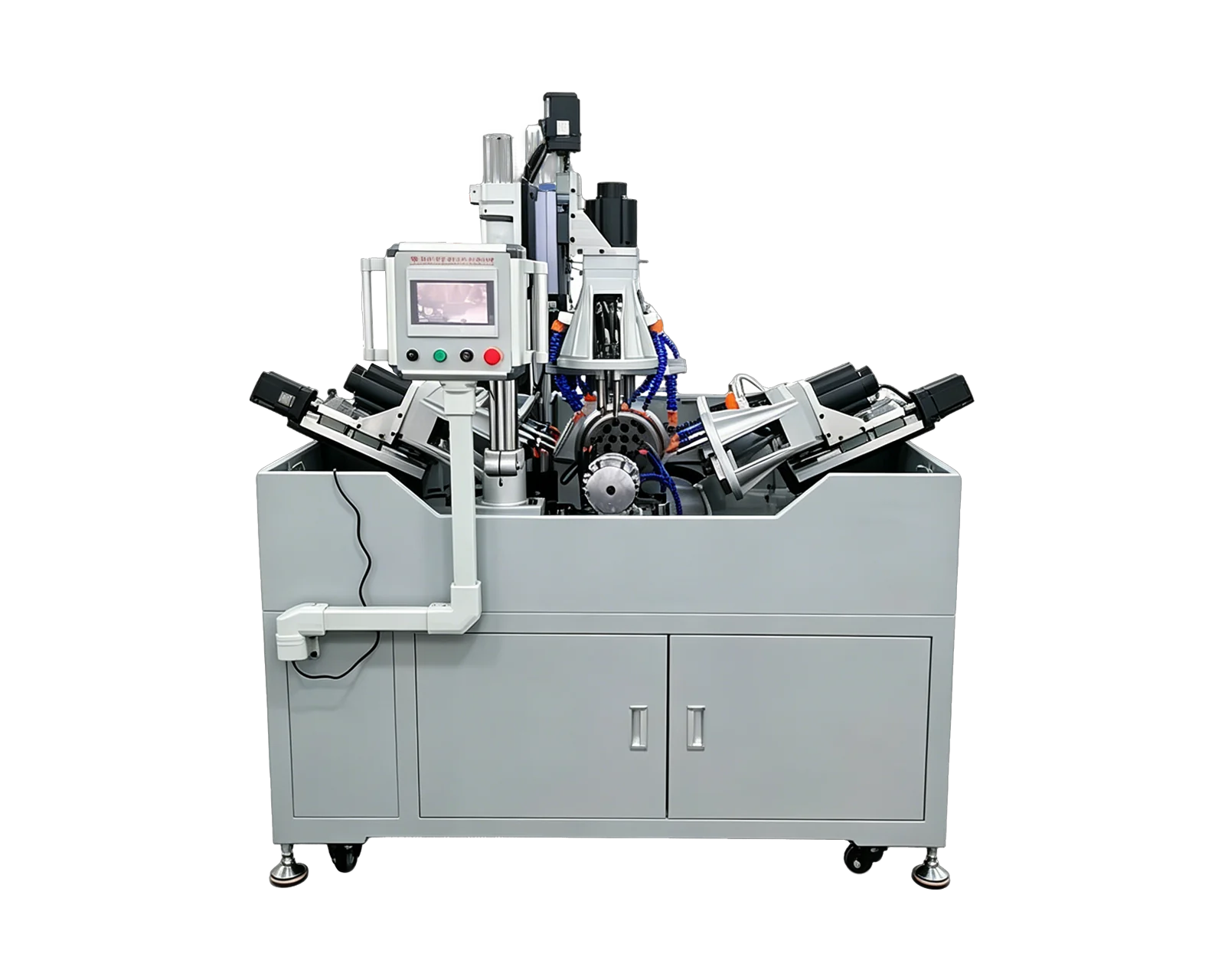
Explore equipment for your inquiry
Multi-Side Drilling & Tapping →Review the layout options and required part information to define the scope of a custom equipment inquiry.
1. Map the relationships that matter
Start with a face-by-face feature list. Mark the drilling and tapping required on each face, then identify the dimensions connecting features across faces. Include the drawing datums and the surfaces available in the incoming part. The purchasing question is how each route preserves the intended references through the complete process, not simply how many times a clamp closes.
Have your engineering or quality team resolve ambiguous drawing references before requesting a firm proposal. If one route assumes that an upstream operation has already established a locating surface, include that operation in the comparison. Otherwise the alternatives may appear equivalent while relying on different starting conditions.
2. Compare access and relocation together
Ask for a workholding concept for both routes. For a shared fixture, review each tool approach together with supports and clamps. For separate setups, show what locates the part after transfer and how its orientation is recognized. Keep any proposed improvement as an item to demonstrate rather than a benefit inferred from the layout name.
3. Test the decision against a specific component
Hypothetical route comparison: a bracket needs top holes and a side thread related to datum A on the drawing. In route 1, a shared fixture retains the proposed datum-A location during both operations. In route 2, the part is removed after top drilling and loaded into a second fixture. Record what locates the second setup: the same datum surface, a newly machined feature or a different incoming surface. Those choices define different reference chains even if both quotations say two operations.
Draw the chain as incoming datum → first setup → transfer, if any → second operation → finished cross-face check. If a newly drilled hole becomes a locator, ask which condition of that hole the second setup relies on and how it is verified. If a surface must be prepared upstream, include that preparation in both price and process scope. Retaining one fixture does not itself prove the finished relationship; compare the same completed drawing requirements for both routes.
4. Include handling and unfinished parts
Compare the number and nature of transfers, operator responsibilities and part collection requirements. Separate setups may involve intermediate storage; a combined arrangement still needs defined loading, removal and interruption handling. Ask how parts with an incomplete process are identified so the next operation does not assume work has already been completed.
Show the actual production mix and the sequence in which batches change. One route may require fixture changes at several positions, while another may require a more involved combined setup. Request a named transition between representative part variants, including the first-part checks. A picture of either completed setup does not describe the work needed to change jobs.
5. Select using comparable finished-part evidence
Use the same drawing revision, material and incoming condition for demonstrations of both routes. Define the finished checks with your quality team, including cross-face relationships that a photograph cannot establish. Record which fixtures, tools and handling actions are included, and distinguish a single successful sample from the broader production requirement you intend to agree.
BINSING multi-side configurations combine machining approaches around a reviewed workpiece, while standard platforms can be considered for individual operations. Request a process comparison before committing to either route. Where access or locating remains unresolved, keep it visible as an engineering question rather than treating a machine photograph as a final fixture design.