
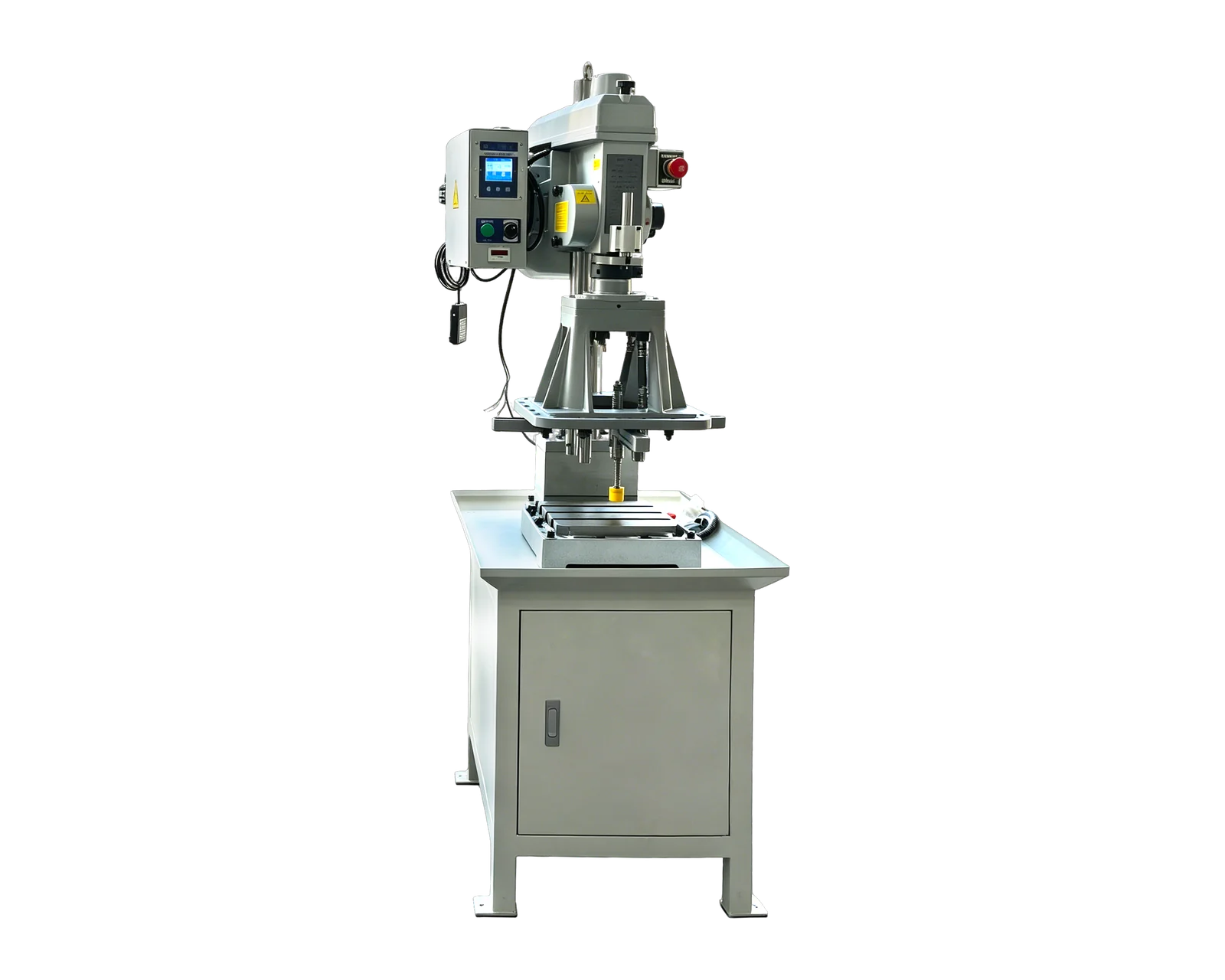
Explore equipment for your inquiry
Automatic Tapping Machines →Compare tapping platforms and feeding options before defining your thread-machining inquiry.
1. Make every depth reference explicit
A purchasing drawing should distinguish the finished thread requirement from the hole that exists before tapping. Mark the surface from which each depth is measured. If a dimension refers to usable full thread, say so; if it describes a drilled hole, identify the intended depth convention and bottom geometry. Do not let a supplier infer these definitions from an undimensioned section view.
Include any entry chamfer, recess or counterbore that changes the starting reference. Where the drawing leaves room for interpretation, resolve the ambiguity with your design or quality team before confirming the equipment scope. The aim is to give the tooling reviewer one consistent description of the finished feature and the available space beneath it.
2. Give the tooling review enough information
Keep the following items together in the inquiry, ideally on a marked section view. An equipment photograph can explain the intended platform, but it cannot establish whether a tool has sufficient room for the specified blind feature. Ask the proposal to identify any missing dimensions or assumptions before those assumptions become an order requirement.
3. Clarify who prepares and cleans the hole
State whether BINSING is being asked to assess tapping alone or a drilling-and-tapping sequence. For tapping-only equipment, describe the holes as delivered to the station, including any variation already known from production. If drilling is included, keep the drilling and tapping requirements distinct so the proposal can explain how the two operations relate.
Ask how chips are managed within the proposed arrangement and what cleaning remains outside it. Also identify any finished-part cleanliness requirement that affects the next assembly or inspection step. This is a scope discussion, not a request to choose cutting settings yourself: tooling selection, bottom allowance and the machining approach need confirmation for the actual part.
Before accepting a tapping-only quote, attach actual incoming-hole measurements or identify who will supply them. For a combined drilling-and-tapping quote, ask who owns the prepared-hole result as well as the thread result. Keep hole preparation, tapping and any final cleaning as explicit handover points, so an acceptable thread sample does not silently close an unresolved hole-depth requirement.
4. Resolve a depth mismatch before selecting the model
Illustrative purchasing scenario: a buyer submits two housing variants with the same thread designation. Their usable thread requirements match, but one variant has less space below the thread. Treat them as separate review cases. A successful trial on the deeper hole would not, by itself, confirm the shallower version.
Ask the supplier to state which variant was assessed, which tooling was considered and whether either drawing needs clarification. Do not solve the mismatch by silently reducing the usable thread requirement. If the product design can change, obtain the appropriate drawing approval and issue a new revision before comparing revised equipment proposals.
5. Agree what the trial must demonstrate
Define the thread inspection requirement with your quality team and record it in the trial plan. Identify the drawing revision, material, prepared-hole condition and variants represented by the samples. A machine running through its programmed movement demonstrates motion; the finished samples and agreed checks establish whether the specified feature was produced.
The BX-4508V and BX-20015 are possible catalog starting points for a tapping discussion. Their drive descriptions do not establish blind-hole suitability. Shortlist a platform only after the application review connects the actual depth requirements, fixture, tooling and process scope with a defined acceptance method.
Put the required usable thread depth, the proposed check and the recorded result on the same feature ID. A successful fastener assembly or a thread-gauge result should not be treated as a depth record unless the agreed inspection method actually verifies that requirement. When two variants have different available bottom space, retain separate sample results and an explicit coverage decision.
